EEG Applications
This module focuses on BCI Applications that are using EEG since it is the cheapest and most mature technology available. You'll soon see that a wide variety of applications can be built with them.
Updated November 2026: checked every company and product link, marked products and companies that are gone, corrected the BrainScope, Akili, and epilepsy statements, and added a 2016 meta-analysis on neurofeedback for ADHD.
Most of this lesson was written in 2017. Consumer neurotechnology changes quickly, so some products below are no longer sold. The research references are still useful starting points. Neurofeedback evidence varies a lot between conditions. A study cited here does not mean a treatment is proven or approved.
NeuroEntertainment
Neurogaming
Emotiv and NeuroSky are two companies which has developed games to go along with their eeg headset, however it seems as though Emotiv has stopped selling them. If you are interested in playing brain controlled games, you can start with Neurosky, whose app store still lists games for its headsets. Otherwise you might try your luck in finding some open source games.
References
- NeuroSky store
- Brain Fighta, an open source eeg game (archived since 2017)
NeuroToys
There have been multiple manufacturers of BCI toys going back to the mid 2000's. Here are some of the more popular ones.
References
- Puzzlebox has various BCI devices (archived page; the live site no longer shows content)
- There are also Star Wars-themed toys!
Art
Multiple people have use EEG's for art and music generation. Below are a few example of some these projects.
References
- Axon Art Collective. A Series of projects doing brain controlled art and music
- Manipulating water with eeg
- EEG Visulization tool
Virtual Reality
Due to the design of VR headsets, there are been an interest in integrating eeg into them. This can help to enhance the experience for the user, as well as provide a hands free approach to interact with the virtual world.
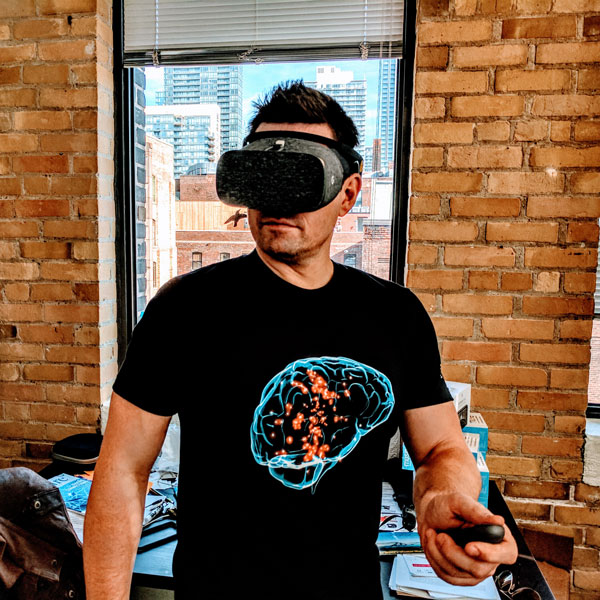
There are a few companies who have been interested in bring EEG data with VR headsets as seen below.
References
- Neurosky's article on the subject
- Article on MindMaze. The company now operates as MindMaze Therapeutics and focuses on rehabilitation.
- DG Lab's VR Zen Headset
- Neurable. Neurable started with BCI for VR. It now sells headphones with built-in EEG sensors.
Security
Brain based authentication
EEG Biometrics is a growing field which looks at how we can use your eeg activity to be able to identify someone. Similar to one's fingerprint, your brain activity can be used as a form of authentication. The most common forms of Brain Authentication are using resting state brain activity or a visual evoked potential task. For more information on Brain Based Authentication, check out this DEF CON talk.
References
Biofeedback Therapy
Anxiety
Neurofeedback can be an effective method of handling anxiety. Similar to the methods used in mindfulness practices, alpha and theta training is done in order to put the person in a more relaxed state of mind.
References
- Neurofeedback for mood and anxiety disorder
- Treatment of Anxiety disorder with neurofeedback
Sleep Improvement
Sleep research has been using EEG's for a long time. Recently, startups have been leveraging consumer grade eeg designs to measure the quality of your sleep.
References
- iWinks (archived page; the site is offline)
- Neuroon (archived page; the site is offline)
- Sleep Shepherd
ADHD
Although a controversial use case, there are many neurofeedback clinics and few companies who have created solutions to help manage ADHD.
A 2016 meta-analysis of randomized controlled trials found effects on ADHD symptoms when ratings came from people who knew which treatment was given. Effects were not significant with probably blinded ratings or in trials with sham or active controls. The authors concluded that well-controlled evidence did not yet support neurofeedback as an effective ADHD treatment.
References
- Cortese et al. (2016), Neurofeedback for ADHD: meta-analysis of randomized controlled trials
- Akili Interactive. Akili grew out of Adam Gazzaley's lab at UCSF. Its game engine builds on NeuroRacer, a game the lab tested with EEG: in Anguera et al. (2013), older adults who trained on it improved at multitasking, and EEG showed stronger midline frontal theta, a marker of cognitive control. Akili's product, EndeavorRx, is a prescription video game for children with ADHD. EEG was used in the research behind it, but the game itself does not record EEG.
- Attentiv (archived page)
PTSD
PTSD neurofeedback has been studied for over 25 years. A lot of the studies focus on getting the participants to generate alpha wave activity which is associated with being in a relaxed state. Most articles which were reviewed suggest that neurofeedback should be use in combination with other treatments.
References
- Alpha-Theta Brainwave Neuro-feedback for Vietnam Veterans
- Neurofeedback as an adjunct therapy for treatment of PTSD
Cognitive Training
Performance Optimization
This series of articles discuss how you can you use Neurofeedback as a mechanism to optimizing performance. This is a good series of articles to start with if you want a high level overview.
References
- EEG Neurofeedback for optimizing performance 1
- EEG Neurofeedback for optimizing performance 2
- EEG Neurofeedback for optimizing performance 3
Brain Ageing
One of the more common services which neurofeedback clinics provide is to combat brain ageing. Researchers are studying whether QEEG markers can help predict future cognitive decline and the onset of Alzheimer's. These markers are still a research topic, not an established clinical test.
References
- Video games for cognitive enhancement - Adam Gazzaley Lab
- QEEG neurofeedback for Dementia
- Beta and gamma neurofeedback on memory and intelligence in the elderly
- Attential Training via neurofeedback in ageing bring
- QEEG in Aging and evolution of Dimentia
- Ref-6
Early Development
Most articles looking into the use of EEG as a Neurofeedback tool for early development tend to focus using it for treatment of ADHD. However, there might be other use cases as well.
References
- Cognitive Training enhances brain connectivity (Measured via MEG)
- EEG and behavioral changes after neurofeedback treatment in learning disabled children
- ADHD and neurofeedback: a double-blind feasibility study
- EEG neurofeedback of SMR and beta frenquency for treatment of ADHD
- Study on the effects eeg neurofeedback on children with ADD and learning disabilities
- Use of QEEEG-Neurofeedback for children with a history of abuse and neglect
Mindfulness
At a consumer level, mindfulness is one of the most common use case for EEG neurofeedback. Here are a few research articles as well as products that currently exist on the market.
References
- Muse Research
- NeuroSky's app store, which lists meditation apps. The original mindfulness app page is no longer online.
- Neurophysiology review on Neural Oscillations and Mindfulness
- Alterations in brain activity produced by mindfulness meditation
Accelerated Learning
The use of neurotechnology to accelerate learning is one of the subjects that remains of high interest, especially to DARPA. Here are some potential use cases of how you can use eeg to speed up your learning.
References
- Use of B-Alert's EEG to create "Accelerated Learning"
- Memory consolidation theta neurofeedback
- Non-invasive Brain biomarkers for cognitive-motor performance assement
Enhanced creativity
One potential use case of neurofeedback training could be used to improve creativity. There has been a growing interest in exploring theta/alpha training. Based on the eeg paradigm which are being study, there is probably a lot of similarity to mindfulness training.
References
- modulating slow waves EEG to enhance musical performance
- A theory of alpha/theta neurofeedback to improve creative performance
Rehabilitation
Stroke Recovery
Neurofeedback provides a potential opportunity to help patients recover from Stroke via neurofeedback. One case study, where on a 55 year old male had increased left-side activity within the 4-7 Hz range, used a neurofeedback therapy which aimed to decrease that frequency as well as increase activity within in the 15-21 Hz range in the sensorimotor and speech areas of the brain. By the end of the treatment the patient had improved speech and the depression and anxiety were gone.
References
- Effects of EEG based neurofeedback training on memory function of post-stroke victims
- Neurotherapy for stroke rehabilitation
- The role of biofeedback in Stroke Rehabilitation: Past and Future Directions
Addiction
The use of EEG biofeedback has been a subject of interest all the way back to the 1970's. There are some interesting connections in the change of eeg activity and drug dependency and the potential of eeg neurofeedback to help treat substance use disorders. This may allow for future neurofeedback products to be created.
References
- EEG Biofeedback for Addictive Disorder
- EEG Biofeedback as a Treatment for Substance Use Disorders
- QEEG analysis of crack cocaine dependence
Rett Syndrome
Neurofeedback may provide a potential therapy to help those with Rett syndrome. Although it will not provide a complete relief, it can still help patients to manage its symptoms and have a better quality of life.
References
Diagnostics
Concussion
Research has shown that there are noticeable changes in EEG oscillations after brain injury. This leads to the potential of creating eeg diagnostics. Current solutions like BrainScope do not diagnose a concussion on their own. BrainScope says its device helps clinicians assess the likelihood of a brain bleed that would show on a CT scan, and is not a substitute for a head CT.
References
- Change in neural oscillations bands of mild traumatic brain injury patients
- Head injury assessment tool by Brainscope
- EEG changes in mild traumatic brain injury in athletes
Alzheimer’s
A growing body of evidence suggests that EEG analyses can be used in the early detect of Alzheimer's and may even allow for the diagnosis for different dementia subtypes. Most of the research has been done in academic environments, however there could be the potential to develop low cost medical testing devices.
References
Epilepsy
Epilepsy affects around 50 million people worldwide, and nearly 80% of them live in low- and middle-income countries, according to the World Health Organization. There are some great opportunities in developing a low cost Epilepsy diagnostic with EEG's and which would help those that may not have the resources to properly test for the disorder.
References